What Can Sale Particulars Tell Us About a Property?
As family and local historians, we are often delighted to find a census return, a title deed, or perhaps an old photograph. Yet one of the most overlooked sources for understanding a property is the auction sale catalogue or particulars of sale.
Recently, I had the opportunity to examine the particulars for the sale of Northease Farm, Rodmell (held at The Keep (East Sussex Record Office) under reference ACC 8797/7), part of the Marquess of Abergavenny’s Sussex estates, offered for sale in 1919. At first glance, it appears to be little more than a sales brochure. In reality, it provides a remarkable snapshot of the farm, its buildings, its tenants, and the surrounding landscape at a specific moment in time.
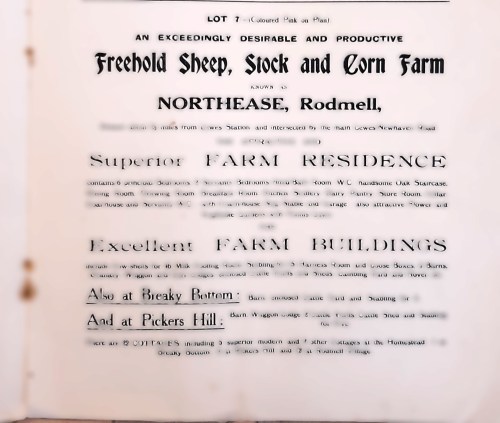
The catalogue describes Northease as an “exceedingly desirable and productive freehold sheep, stock and corn farm” extending to just over 1,047 acres. Immediately, we gain an understanding of the scale of the operation. This was not a modest family holding but a substantial agricultural enterprise.
The details of the farmhouse are equally revealing. The residence contained six principal bedrooms, two servants’ bedrooms, a dining room, drawing room, breakfast room, dairy, pantry, cellar, coach house, stable and garage, together with flower and vegetable gardens and even a tennis lawn. From this description alone, we can begin to picture the social status of the occupier and the lifestyle associated with the farm in the years immediately following the First World War.
The catalogue also provides a detailed inventory of the farm buildings. Cow sheds for forty-six cattle, stabling for fifteen horses, barns, granaries, harness rooms, lambing yards and cattle sheds paint a vivid picture of a mixed farming operation before widespread mechanisation transformed British agriculture. The presence of accommodation for horses reminds us that tractors were still far from universal in 1919.
Perhaps most useful of all is the accompanying plan. The coloured map identifies every field, road, cottage and farm building within the lot. Each numbered parcel corresponds to a schedule listing its acreage and use, whether arable, pasture, marsh, buildings, cottages or roads. Such information can help researchers identify historic field names, reconstruct farm boundaries, and understand how land was being utilised over a century ago.
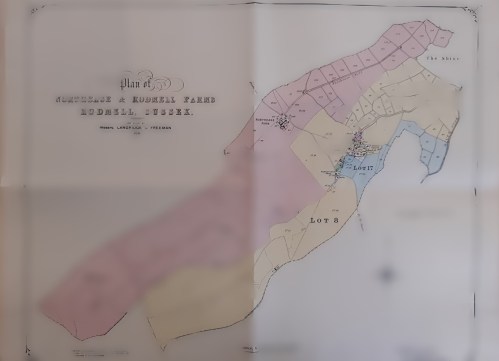
The particulars reveal much more than simply the land itself. We learn that the farm was occupied by a tenant, James Stacey, whose tenancy was due to expire at Michaelmas. We discover rights of way across the property, the existence of a freehold quit rent payable to the Crown through the Manor of Piddinghoe, and even practical arrangements concerning water supply and agricultural equipment that would pass to the purchaser.
One particularly striking detail is the mention of 22 cottages associated with the estate, including properties at Rodmell village, Pickers Hill and Breaky Bottom. This reminds us that many large farms functioned as small communities, housing labourers and their families alongside the principal farming operation.
For property historians, auction particulars can therefore provide information unavailable elsewhere. They combine elements of a map, valuation, estate survey, tenancy agreement and property description in a single document. They can help answer questions such as:
- What buildings existed at a particular date?
- How was the land being used?
- Who occupied the property?
- What rights and obligations affected the estate?
- What was considered noteworthy enough to attract prospective purchasers?
Most importantly, they allow us to move beyond names and dates and begin to understand how a property actually functioned.
The next time you come across a bundle of sale particulars in an archive or record office, do not dismiss it as merely a sales brochure. It may well be one of the richest sources available for understanding the history of a house, farm or estate, offering a detailed snapshot of a property and the people connected with it at a specific moment in time.
For historians and genealogists alike, that glimpse into the past can be invaluable.

