What Chancery Interrogatories and Depositions Can Tell Us
This week, as we head towards the summer break, I’ve been immersed in a fascinating bundle of seventeenth-century Chancery records relating to a long-running inheritance dispute over property in Bagshot and Windlesham, Surrey. Like many researchers, I originally went looking for the bill of complaint, expecting it to provide the key details of the case. Instead, I found myself spending far more time with a different set of documents – the interrogatories and depositions.
For anyone researching family or local history, these are often the real treasures.
What are interrogatories?
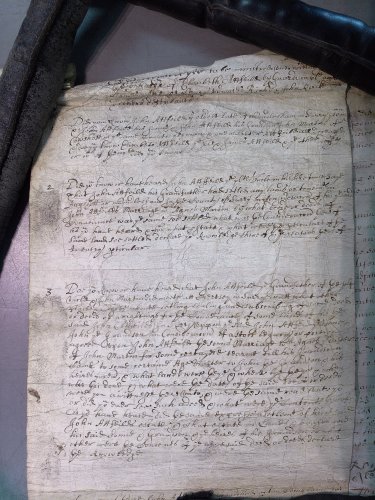
Once a Chancery case reached the evidence-gathering stage, each side prepared a series of written questions, known as interrogatories. These were put to witnesses under oath by commissioners appointed by the Court.
Unlike modern court proceedings, witnesses were not generally cross-examined in open court. Instead, they answered a carefully prepared list of questions. The responses were written down, signed or marked by the witness, and returned to Chancery as formal depositions.
In the case I’ve been studying, each side prepared its own set of interrogatories. The questions were designed to establish exactly the points each party needed to prove.
What do they ask?
The interrogatories in Atfield v Atfield which I have been looking at to use as an example in a forthcoming talk, are surprisingly detailed.
They ask witnesses whether they knew various members of the Atfield family, how long they had known them, what they knew about the ownership of land in Bagshot, whether they had seen particular deeds, whether they had witnessed conveyances, and who had been in possession of the disputed property over many years.
Some questions are very specific, asking about individual deeds and settlements. Others explore reputation and local knowledge – who the neighbours believed owned the land, who collected the rents, and who exercised control over the property.
Reading the questions alone gives a remarkably clear picture of the legal issues at the heart of the dispute.
The depositions bring the family to life
The witness depositions are even more revealing.
Rather than simply confirming ownership, they preserve the memories of people who had known the family for decades. Witnesses describe relationships between different branches of the Atfield family, recall old agreements, explain who occupied particular properties, and identify neighbours, relatives and local landowners.
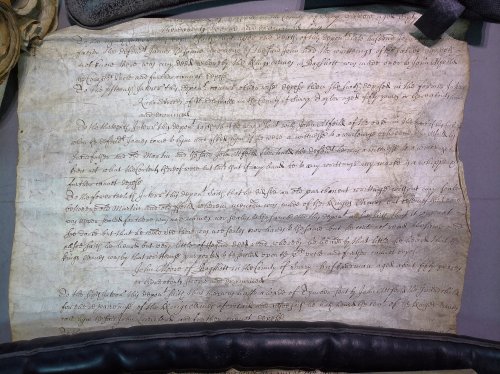
The evidence is not limited to legal title. It also records what people remembered, what they had heard over the years, and how the ownership of the property was understood within the local community.
For a family historian, this is invaluable.
More than just a lawsuit
What has struck me most is how these documents go far beyond the dispute itself.
From a single set of interrogatories and depositions it is possible to identify:
- three generations of the same family;
- married daughters and their husbands;
- infant heirs;
- neighbours and witnesses;
- occupations and places of residence;
- references to lost deeds;
- long-term possession of property;
- and even the community’s collective memory of who owned what.
These are precisely the kinds of details that rarely appear together in parish registers, wills or deeds.
One dispute – many cases
The depositions also turned out to be just one part of a much larger story.
As I worked through the records, I discovered that this was not a single Chancery suit but a series of interconnected cases running from 1659 to 1682. Different branches of the Atfield family, together with the Lugg, Edwards and Roake families, repeatedly returned to Chancery as the dispute evolved.
The result is an extraordinary paper trail that documents more than twenty years of one family’s history.
A reminder to look beyond the bill
It’s easy to stop once you’ve found the bill of complaint or the answer. After all, they’re the documents most commonly cited in catalogues and guides.
But if interrogatories and depositions survive, don’t overlook them.
In many cases they contain the richest genealogical evidence of all, preserving voices, memories and relationships that survive nowhere else.
This week’s research has certainly reminded me that, in Chancery, some of the most valuable evidence lies well beyond the opening pleadings.

