This week I have spent more time looking through deeds, particularly in an attempt to trace the ownership and occupation of a property in my village of Cranleigh, Surrey, which was once a grand Georgian house.
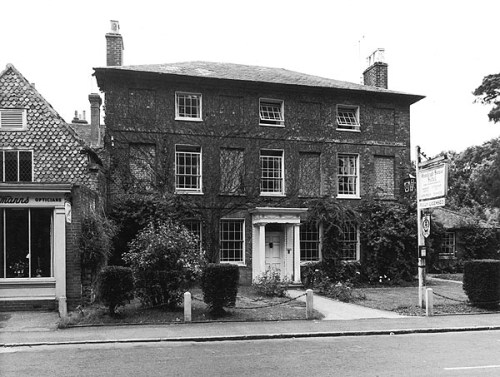
The property, known as Cranley House, most likely dated from the late eighteenth to early nineteenth century (roughly 1770–1830), although later alterations were clearly made over time. Looking at a photograph held at Surrey History Centre (Reference CC1101/3/46/27), it also appears that some of the windows had been bricked up.
In its latter years it was converted into the Cranley House Hotel (not to be confused with The Cranley Hotel at the opposite end of the village) before being demolished in the early 1980’s to make way for the new library building, which opened in 1985.
It is possible that the blocked windows were the result of Window Tax. Introduced in 1696 under King William III, the tax was designed as an indirect way of taxing wealth, based on the assumption that those with larger houses and more windows could afford to pay more.
The tax was altered several times during the eighteenth century, with rates increasing significantly from 1766 onwards, leading many property owners to brick up windows in order to reduce their liability. Although the tax was eventually repealed in 1851, evidence of blocked windows can still be seen on many Georgian and early Victorian buildings today.
The photograph of Cranley House certainly shows recessed or altered window bays which could date from this period, although not every blocked opening was necessarily connected with the tax.
On 12th and 13th October 1832, (Surrey History Centre Reference G85/6/14) by deeds of Lease and Release, the property was purchased by George Holden, a local builder and the first Baptist minister in the village. He bought the property from Ann Smither, a widow. Although the deed itself does not name the property, it describes it as:
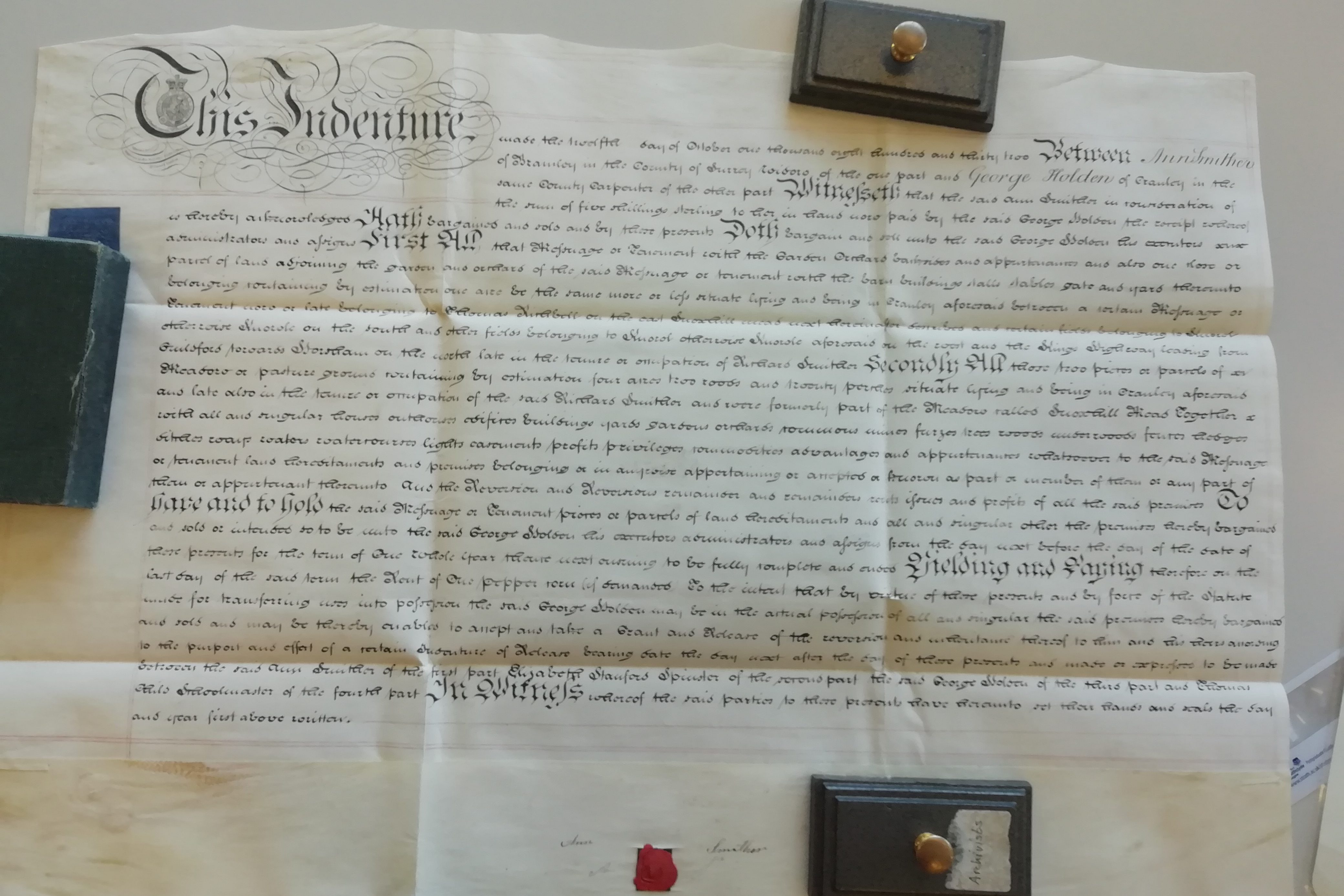
A messuage or tenement with the garden orchard backsides and appurtenances and also one close or parcel of land adjoining the garden and orchard of the said messuage or tenement with the barn buildings stalls stables gate and yard thereunto belonging containing by estimation one acre…. Situate lying and being in Cranley … between a certain messuage tenement now or late belonging to Thomas Richbell on the east, Snoxhill Mead … and certain fields belonging to Knowle on the west and the Kings highway leading from Guildford to Horsham on the north late in the tenure or occupation of Richard Smither [deceased]
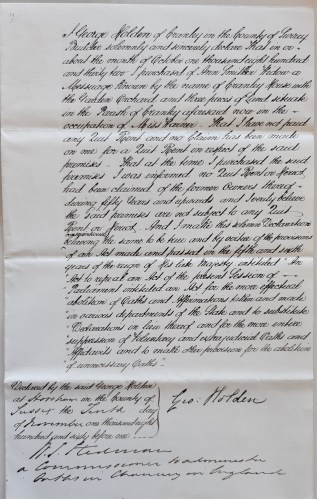
However, the property is identified as Cranley House in a later affidavit (Surrey History Centre Reference G80/6/15) entered into by George Holden regarding the payment of quit rent. In that affidavit, dated 10th November 1860, George stated that he had never paid, nor been asked to pay, any quit rent on Cranley House, which he had purchased from Ann Smither around October 1832.
The description of the property, together with the name of the previous owner, enabled me to trace an earlier transaction: the purchase of the property by Richard Smither in 1809 from Charles Ellis, who himself had inherited the land in 1773 from his grandfather.
At that time, there appears to be no indication that the house had yet been built. Given the likely architectural dating of the property, and the apparent absence of any house in 1773, my conclusion is that Cranley House was most likely constructed by Charles Ellis sometime between inheriting the land and selling it to Richard Smither in 1809.
What began simply as curiosity about an old photograph has therefore started to reveal something of the development and ownership of one of Cranleigh’s former Georgian houses, and perhaps also a small surviving reminder of the effects of Window Tax on the built environment of the village.

