Tailors and the Growing Clothing Trade in Victorian Stroud
During my research this week, I found myself following an interesting occupational trail which led me from Suffolk to London and eventually to Stroud in Gloucestershire. It got me thinking about the movement of skilled tradesmen during the Victorian period and, in particular, the changing nature of the tailoring trade.
The nineteenth century was a period of considerable change for the clothing industry. Traditional tailoring, with garments individually cut and made for customers, was increasingly being joined by factory production and the growing market for ready-made clothing. For skilled workers, these changes brought new opportunities, but also meant that they sometimes had to move to find work.
One particular piece of family history research provided an interesting starting point for exploring this.
A trade passed down through generations
Tailoring was often a family occupation, with skills passed from father to son and sometimes across several generations. Learning the trade involved considerable practical skill, from measuring and cutting cloth to fitting and making garments.
In the case I was researching, the father was recorded as a tailor in the mid-nineteenth century, and his son subsequently followed him into the same occupation.
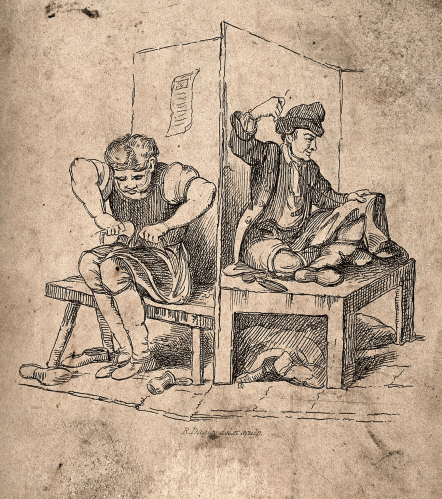
Tailoring was often a family occupation, with skills passed from father to son and sometimes across several generations. Learning the trade involved considerable practical skill, from measuring and cutting cloth to fitting and making garments.
In the case I was researching, the father was recorded as a tailor in the mid-nineteenth century, and his son subsequently followed him into the same occupation.
By the 1870s, the younger man was working in London, where he was described as a tailor’s cutter. His marriage records also revealed an interesting occupational connection: his father-in-law was a cutter too.
It is quite possible that working relationships helped bring the couple together, although the records cannot establish this with certainty.
The distinction between a tailor and a cutter is worth exploring. Cutting was a skilled part of garment production, requiring an understanding of measurements, patterns, fabric and fit. A cutter could work in a traditional tailoring establishment or within the increasingly mechanised clothing industry.
The changing face of the clothing trade
During the nineteenth century, the production of clothing was undergoing significant transformation.
For centuries, most clothing had been made by hand, either by individual tailors and dressmakers or within smaller workshops. Ready-made clothing was not entirely new, but improvements in machinery, transport and manufacturing methods helped it develop into a much larger industry.
The sewing machine was particularly important. Its introduction and subsequent development made it possible to increase production considerably, although skilled workers were still needed for cutting, assembling and finishing garments.
Clothing manufacture also created opportunities beyond the factory itself. Many workers undertook sewing and finishing work at home, while others were employed in workshops and larger manufacturing establishments.
This was a period when the traditional tailor and the factory clothing worker could be found operating alongside one another.
Why Stroud?
One of the things that particularly interested me in this research was the family’s eventual move to Stroud in Gloucestershire during the early 1880s.
Stroud is perhaps best known for its long association with the woollen industry. The surrounding valleys were home to numerous mills, which had developed over centuries using the water of the River Frome and its tributaries.
The town was particularly associated with the production of fine woollen cloth, including the famous Stroudwater Scarlet.
However, by the nineteenth century, Stroud was also developing an important clothing-manufacturing industry.
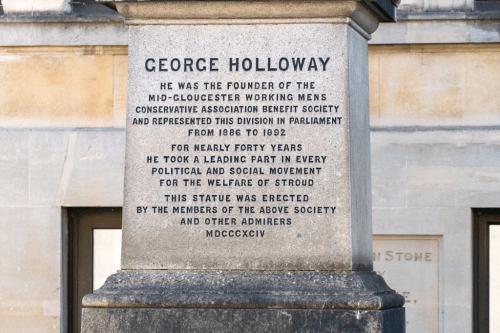
One of the most significant businesses was Holloway Brothers, established in 1849 by George and Henry Holloway. Initially operating as a dressmaking business, the brothers recognised the potential of mechanised clothing production.
In 1854 they established a factory in Threadneedle Street, employing around 50 people and producing approximately 1,200 pairs of trousers each week.
They were innovative in their use of machinery and became particularly associated with the introduction of steam-powered sewing machines.
The business continued to expand, and by 1890 it employed around 1,500 people.
This was a considerable undertaking for a town the size of Stroud and illustrates just how important the clothing industry had become to the local economy.
Opportunities for skilled workers
The growth of businesses such as Holloway Brothers created demand for a wide range of skilled workers.
Cutters were particularly important. Their work involved laying out and cutting the individual pieces of fabric needed to construct garments. Accuracy was essential, as mistakes could result in wasted material and poorly fitting clothing.
There were also opportunities for tailors, machinists, seamstresses and those undertaking finishing and alteration work.
For a skilled tailor or cutter living elsewhere in the country, a town such as Stroud could therefore offer attractive employment prospects.
It is difficult to know precisely what motivated every individual to move, but the expansion of the clothing industry provides an interesting context for the migration of skilled workers into the area during this period.
The railway also made moving across the country considerably easier. Journeys that might once have been difficult and time-consuming were becoming more accessible, allowing workers to travel in search of employment.
A growing town
The expansion of industry brought changes to Stroud itself.
As employment opportunities increased, so did the demand for housing. New residential developments appeared around the town, accommodating the growing population of workers and their families.
The Victorian town was a mixture of established artisan communities, industrial premises and newly developed residential streets.
For tradesmen and their families, finding suitable accommodation close to employment was an important consideration. Many working-class families rented their homes, and moving between properties was not unusual as circumstances changed.
The census returns and electoral registers of the period can be particularly useful in tracing these movements, providing a picture of how families became established in their new communities.
Following the trade
What I particularly enjoyed about this week’s research was the way in which a relatively small piece of family history opened up a much wider subject.
An occupation recorded in a census return can be so much more than just a label. It can lead us into the history of an industry, the development of a town and the movement of people in search of work.
The Victorian tailoring trade was changing rapidly, with traditional skills adapting to new methods of production and an expanding market for ready-made clothing.
Stroud provides an excellent example of how an established textile town developed into an important centre for clothing manufacture.
And it is a reminder that when researching our ancestors, following their occupations can sometimes take us in some very unexpected directions. Sometimes, all it takes is a little needle and thread!

