An Underrated Resource for Local History Research
When researching the history of a village, parish or town, it is easy to concentrate on the familiar sources: parish registers, wills, deeds, manorial court rolls and the occasional surviving rental. These records can reveal a great deal about the people who lived in a community, the property they occupied and the relationships between families. But what happens when we want to discover more about the wealth of the population, identify inhabitants who appear in few other records, or establish a picture of a community before parish registers began?
One source worth exploring is the lay subsidy. These medieval and early modern taxation records can provide valuable evidence for local and family historians, particularly when used alongside other contemporary documents.
What were lay subsidies?
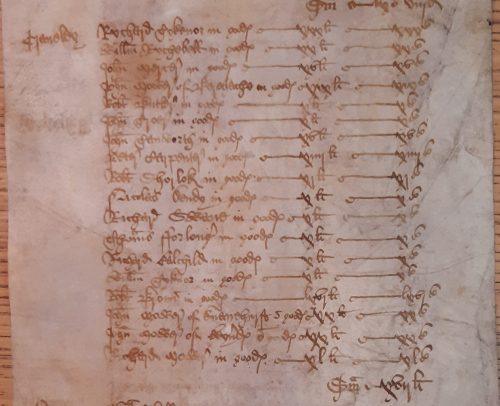
Lay subsidies were taxes imposed by the Crown on the wealth of the lay population – that is, people who were not members of the clergy. They were raised to provide revenue for royal government, often to meet the costs of war or other major expenditure.
The origins of lay taxation lie in the medieval period, but subsidies became particularly important sources for historians studying the sixteenth and seventeenth centuries. The tax was generally assessed on property or wealth, rather than simply on the number of people in a household.
The precise basis of assessment varied over time. Some subsidies were levied on movable goods, while others assessed land or income from land. The rate, exemptions and administrative arrangements also changed, so it is important to understand the particular tax being examined rather than assume that every return was compiled in the same way.
For the local historian, these differences matter. A person assessed on goods was not necessarily being taxed on the same basis as someone assessed on land, and the absence of a name does not automatically mean that the individual was not living in the parish.
What information can lay subsidies provide?
The surviving returns vary considerably in their detail and completeness, but they may identify taxpayers by name, parish or township, and the amount or type of wealth assessed.
Their principal value is that they offer a snapshot of a community at a particular point in time. Although they are not population censuses, they can help us reconstruct the social and economic structure of a settlement.
Identifying inhabitants
Lay subsidies can provide evidence for individuals who may be difficult to identify in other records. This is especially useful before the systematic survival of parish registers, although subsidies can also help bridge gaps in later periods.
A name recorded in a subsidy can be compared with entries in manorial court rolls, deeds, wills and other records. These comparisons may help distinguish between people of the same name and establish a chronology of an individual’s activities.
However, names alone rarely provide definitive identification. Where possible, I would look for corroborating evidence from property descriptions, family relationships, occupations and neighbouring taxpayers.
Investigating wealth and social structure
Tax assessments can offer an indication of the relative wealth of individuals within a community. They may help distinguish between those with substantial taxable assets and those assessed at lower levels.
This can be particularly useful when studying how a village was organised socially and economically. Were there a small number of comparatively wealthy landholders alongside a larger group of modest taxpayers? Did the same families appear repeatedly among the more substantial assessments? Were there changes in the distribution of taxable wealth over time?
The answers may help us understand the community beyond the names of its principal landowners.
It is important, however, not to equate the amount assessed directly with total personal wealth. Taxable assets were only one part of a person’s economic circumstances, and exemptions, assessment practices and the type of subsidy imposed could affect the result.
Reconstructing households and communities
Although lay subsidies were not designed to record households in the way that later census returns did, the arrangement of names within a return can sometimes offer clues about local relationships and settlement patterns.
The order in which taxpayers appear may reflect administrative divisions, the organisation of the assessment or the sequence in which officials recorded them. It should not automatically be interpreted as evidence that two individuals lived next door to one another.
Nevertheless, when the names can be matched to properties identified in manorial records, deeds or other sources, subsidies can contribute to a broader reconstruction of the settlement.
Using lay subsidies alongside manorial records
For anyone researching the development of a village, one of the most productive approaches is to combine lay subsidies with manorial records.
Manorial court rolls and rentals can identify tenants, record transfers of copyhold property, and sometimes provide information about inheritance, family relationships and the occupation of land. Lay subsidies offer a different perspective by recording people in the context of taxation.
Consider a hypothetical example. A manorial court roll records John Smith taking over a copyhold holding following the death of his father. A lay subsidy compiled a few years later lists a John Smith among the taxpayers of the parish.
The two entries may relate to the same individual, but the identification needs to be tested. Is the chronology consistent? Does the manorial entry provide an occupation or property description that can be linked to other evidence? Are there other men of the same name in the parish?
If the identification is supported by additional records, the subsidy can contribute to a more complete picture of the individual’s economic position and place within the community.
The same approach can be used to investigate the relationship between property ownership, occupation and taxable wealth. Someone who appears frequently in manorial records but is absent from a subsidy might prompt further investigation, although that absence alone cannot establish why they were not assessed.
A case study approach: researching Cranleigh
In my own research into the development of Cranleigh between approximately 1550 and 1700, Tudor and Stuart lay subsidy returns form part of a wider body of evidence used to reconstruct the village’s population, property holdings and social structure.
The challenge is not simply to collect names. It is to establish how individuals, families and properties relate to one another across different record series.
A name in a lay subsidy may provide a starting point for further research in manorial court rolls, rentals, deeds, wills and Chancery proceedings. Conversely, a person identified in a deed or court roll may be easier to place within the wider community if they can also be found in a taxation record.
This process of correlation is particularly important when studying a settlement over several generations. Individual records provide fragments of information, but when those fragments can be connected, they begin to reveal patterns of continuity and change.
For example, comparing subsidy assessments from different dates may help identify recurring taxpayers or changes in the relative position of particular families. When linked to property evidence, these patterns can contribute to an understanding of how landholding and wealth were distributed within the village.
The returns must still be interpreted cautiously. Changes in assessment, taxation rules and the survival of records can make comparisons difficult. A change in the number of names or the value of assessments does not, by itself, demonstrate population growth or economic decline.
Where can you find lay subsidy records?
For researchers working in England, The National Archives is an important starting point. Its E 179 database provides access to descriptions of taxation records, including lay subsidies, held at The National Archives and elsewhere.
The database is particularly useful for identifying surviving returns for a particular parish, town or county. Searching by place name can reveal which records survive and the dates they cover, although spelling variations and historical administrative boundaries can complicate the search.
You can begin your search through the E 179 database.
It is worth searching for historical spellings of place names as well as modern forms. A parish may be recorded under a variant spelling, or a return may be organised by hundred, borough or another administrative unit rather than by the settlement you are researching.
Once you have identified a relevant record, check the catalogue description and determine whether the original document is available online or needs to be consulted at a repository.
Five tips for getting the most from lay subsidies
1. Establish which tax you are looking at. Check the date, the type of subsidy and the basis of assessment before drawing conclusions about the people listed.
2. Search beyond the modern place name. Try historical spellings and the names of relevant hundreds, townships and neighbouring settlements.
3. Record the source carefully. Note the document reference, date, place, taxpayer’s name, assessment and any additional information supplied by the record.
4. Correlate rather than assume. Use manorial records, deeds, wills and parish registers to test whether a taxpayer can be identified with someone found in another source.
5. Treat absences with caution. Exemptions, minimum assessment thresholds, changes in taxation and incomplete survival can all affect who appears in a return.
An overlooked source worth exploring
Lay subsidies will not answer every question about a village or its inhabitants. They were compiled for taxation, not to provide a comprehensive record of the population, and their value depends on the survival and nature of the particular returns.
Nevertheless, they can be an important addition to the local historian’s toolkit. They may identify otherwise elusive individuals, provide evidence of relative taxable wealth and help connect people found in different record series.
Most importantly, they encourage us to look beyond the records we habitually use. When a taxation return is compared with manorial records, deeds and other contemporary sources, it can contribute to a much richer understanding of a community and its development over time.
For anyone investigating the history of a village before the census, or trying to establish how its inhabitants lived and worked, lay subsidies are well worth adding to the research list.

