This week’s principal research has taken me into the world of Heraldry, not a world I get into very often but after this week, I have a renewed interest and passion for it!
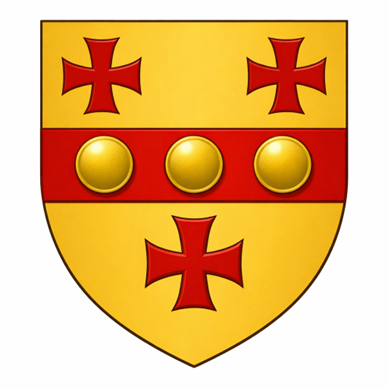
My deep dive into heraldry began with what seemed like a straightforward question: could an English family be directly connected to a Scottish coat of arms? What followed was less a simple verification and more an exercise in understanding two closely related—but critically different—heraldic systems.
At the outset, the visual similarities were striking. Familiar charges and tinctures suggested the possibility of a shared lineage. However, as the research unfolded, it became clear that heraldry demands more than surface-level comparison. It requires an understanding of how arms are granted, inherited, and—crucially—regulated.
Scottish heraldry, like its English counterpart, is rooted in the principle that arms belong to an individual rather than a surname. This was something I initially assumed to be a point of difference, but both systems share that foundation. The real distinction lies in how each system manages descent and entitlement.
Coming from a background more familiar with English heraldry, governed by the College of Arms, I was used to a framework in which arms pass down family lines with relatively little formal intervention. While cadencies exist in theory to differentiate branches, its application is often inconsistent, and inheritance can feel, at times, more customary than procedural.
This assumption proved to be a stumbling block when I turned to Scottish records. Under the Court of the Lord Lyon, heraldry operates with far greater precision. Here, descent is not assumed—it must be demonstrated and recorded. Each descendant is required to matriculate their arms, receiving an officially recognised variation that reflects their exact place within the lineage.
Realising this was a turning point in my research week. What initially appeared to be a dead end—no exact match between the English arms and the Scottish coat—began to look different. The absence of a perfect visual correspondence was no longer a contradiction, but a clue. If a connection existed, it would likely be found in a recorded variation, not a duplicate design.
This shift in understanding reframed the entire investigation. Instead of asking, “Do these arms match?” the more meaningful question became, “Is there a documented line of descent that explains the differences?” That subtle change opened up new avenues—looking at matriculations, lineage records, and the structure of Scottish armorial inheritance rather than relying on visual comparison alone.
By the end of the week, the research had become less about proving a direct link and more about navigating the interplay between two heraldic traditions. England offers flexibility and continuity; Scotland offers structure and documentation. Bridging the two requires not just evidence, but a willingness to adjust one’s assumptions.
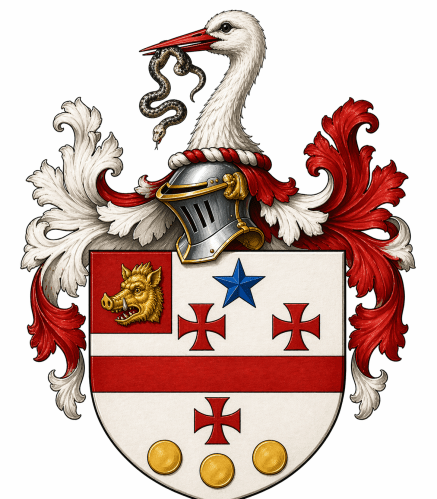
Whether or not a definitive connection ultimately emerges, the process itself has been instructive. Heraldry is often approached as a static system of symbols, but it is dynamic shaped by law, geography, and centuries of evolving practice. Understanding that has been the most valuable outcome of this week’s work.

