From the gallows to a New Life
In the mid-19th century, the English criminal justice system could be unforgiving, particularly in cases involving the deaths of newborn children. One such case was that of Mary Jones, a young woman from the Hambledon area of Surrey whose story did not end with the dramatic sentence pronounced at her trial.
Arrest and Trial
Mary Jones, aged just 19, was arrested on 11 September 1858, charged with the wilful murder of a newborn female child at Hambledon, Surrey on 30 August 1858. Her trial took place at the Kingston-upon-Thames Assizes on 29 March 1859. She was found guilty and sentenced to death.

Yet the story did not end with the verdict.
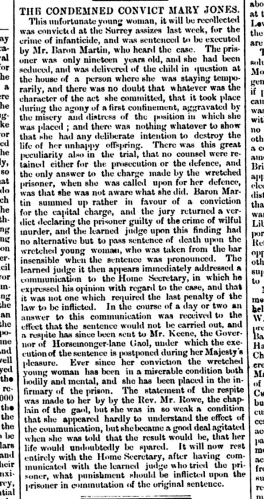
A report in the West Surrey Times, published on 9 April 1859, provides further insight into the circumstances surrounding the case. At the trial, neither the prosecution nor Mary herself had legal counsel. The report suggests that Mary had been seduced and subsequently “delivered of a child,” and that her situation had been “aggravated by the misery and distress of the position in which she was placed.” To modern readers, the details hint at a young woman who may have been forced into circumstances far beyond her control.
Importantly, the article also noted that “there was nothing whatever to show that she had any deliberate intention to destroy the life of her unhappy offspring.”
Despite this apparently sympathetic tone, the report also referred to Mary as a “wretched prisoner.” When asked to respond to the charge, she reportedly stated simply that “she was not aware of what she did.”
Intervention and Imprisonment
Following the conviction, the presiding judge wrote to the Home Secretary, expressing the view that the case was not one in which the ultimate penalty of the law should be carried out. The Home Secretary evidently agreed. Mary’s execution was postponed, and she was sent to Horsemonger Lane Gaol while her case was reconsidered.
Reports described her as being in a “miserable condition both bodily and mental[ly]” after the conviction. She was admitted to the prison infirmary, and when informed that her execution had been postponed she appeared not to fully understand the news, becoming “a good deal agitated.”
Ultimately, her death sentence was commuted to life imprisonment but her records show that she was released on licence after serving 11 years.
Licence Record
Records from her licence papers show that Mary did not spend all of her time in one prison – she was transferred several times:
- 11 May 1859 – Received at Millbank Prison
- 23 August 1860 – Transferred to Brixton Prison
- 16 November 1869 – Received at Woking Prison
- 12 April 1870 – Licence issued via Millbank
- 13 April 1870 – Final licence for release granted (Licence No. 3536)
Her licence records also provide a rare physical description. Mary was described as having a fresh complexion, red hair, and blue eyes. She was 4 ft 11½ inches tall, “rather stout,” and had a small scar over her left eye.
While in prison she attended school and made satisfactory progress, and her prison trade was recorded as needlework.
She twice petitioned for early release:
- 17 January 1862 – Licence denied (“no grounds”)
- 24 April 1867 – Licence denied again
Only in April 1870, after more than a decade in custody, was her release finally granted.
Prison records also list her earnings from prison labour. Between November 1865 and 1870, Mary earned £16 19s 4d. Behaviour reports from 1867–1869 note incidents of bad language, shouting, disobedience, and insolence—perhaps unsurprising given the circumstances of long-term imprisonment.
Unfortunately, the records do not record an address for her on release.
Early Life
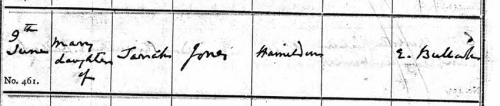
Tracing Mary’s life before her arrest is difficult. Assuming she was local to Hambledon, she was most likely baptised on 9 June 1839 at Hambledon, the daughter of Sarah Jones. The baptism record suggests that Mary may have been born illegitimately, and no corresponding birth registration has been identified.
A possible entry in the 1841 census places her not with her mother but with two men who may have been her uncles, living on Hambledon Common. What happened to her mother is unclear, as no death record for Sarah Jones has been found between 1839 and 1841.
By 1851, no definite census entry for Mary can be confidently identified.
Her licence papers do provide one family connection: her grandfather James Jones of Hambledon. Census and baptism records suggest he was likely the father of Sarah Jones (mother of Mary) and had other children, including William and George, who may have been the men Mary was living with in 1841.
Sadly, James Jones appears to have died aged 75, being buried at Hambledon on 24 April 1863.
After Release
Discovering what became of Mary after her release proved challenging. Without a recorded address in her licence papers, tracking her movements is difficult.
However, a clue appears in the Hambledon Board of Guardians Minute Books. At a meeting on 11 December 1871, the board discussed a woman named Mary Jones who had been suffering from fever while residing in the parish of Godalming, neighbouring Hambledon. The minute records that she had been advised by the relieving officer of the Guildford Union to travel to the Hambledon Union workhouse but collapsed from fever on the way.
A corresponding entry in the Guildford Union minute books, dated 23 December 1871, confirms that a Mary Jones was admitted to the Guildford Workhouse.
While it cannot be stated with absolute certainty, the circumstances strongly suggest that this was the same Mary Jones.
A New Beginning?
Records suggest that Mary’s story did ultimately take a more hopeful turn.
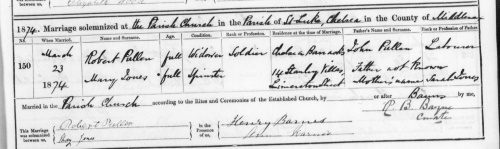
Mary married Robert Pullen, a soldier, in Chelsea on 23 March 1874. The marriage certificate is unusual in that in place of naming a father for Mary it clearly states that she was the illegitimate child of Sarah Jones. The couple went on to have a son named William.
This is truly a story of a young woman who once faced the gallows eventually finding a path back into society—building a family and beginning a new chapter after years of hardship.
 Sarah Pettyfer