A Week Writing Manorial History
This week I have been immersed in manorial records, writing the beginnings of my book on the subject. It truly does feel like stepping back in time into a different world — one parchment line at a time.
A Week Immersed in Medieval Voices
My week has revolved around drafting, refining, and interpreting material connected to manorial documents. Each piece of writing has required balancing historical accuracy with clarity, turning the complex world of feudal and manorial systems into bite-sized, accessible explanations.
Manorial records are easily one of my favourite sets of sources for researching family, house and local history, from medieval England right through to the twentieth century — yes, they really did continue into the last century. They are often overlooked, and yet they contain an extraordinary depth of detail about landholding, inheritance, obligation and community life.
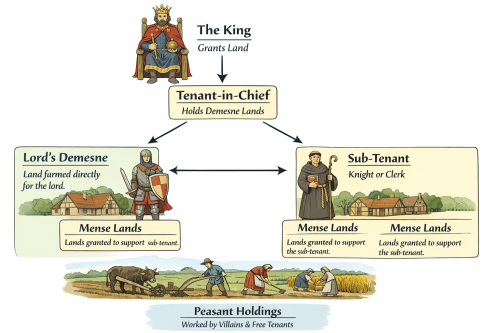
At first glance they can appear dry: lists of tenants, fines, heriots, land transfers. But behind every entry is a life. A widow negotiating her late husband’s holding. A tenant fined for failing to repair fencing. A dispute settled in the manor court. Writing about these moments means reconstructing context without overreaching — staying faithful to the record while allowing the human story to breathe.
Writing Between Abbreviation and Meaning
One of the recurring challenges this week has been working with abbreviated medieval Latin. The scribes of the thirteenth and fourteenth centuries were efficient to the extreme. Suspensions, contractions and formulaic phrasing appear everywhere.
Each time I expand an abbreviation, I find myself asking:
- Is this a standard legal phrase?
- Does the grammatical structure support this expansion?
- Does the context of the manor or jurisdiction suggest a particular formula?
That detective work shapes the writing. The final prose may read smoothly, but beneath it lies careful parsing of grammar, terminology and legal convention.
Contextualising the Manor
Writing within this project also means situating each document within its historical setting. Manorial courts did not operate in isolation. They functioned within wider economic, social and legal frameworks shaped by developments such as the administrative reforms of kings like Henry II, the long reign of Edward III, and the demographic upheaval following the Black Death.
Even when a specific entry makes no explicit reference to such events, their impact lingers in patterns of landholding, labour obligations and court activity.
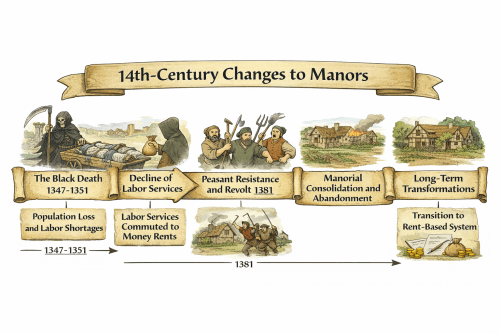
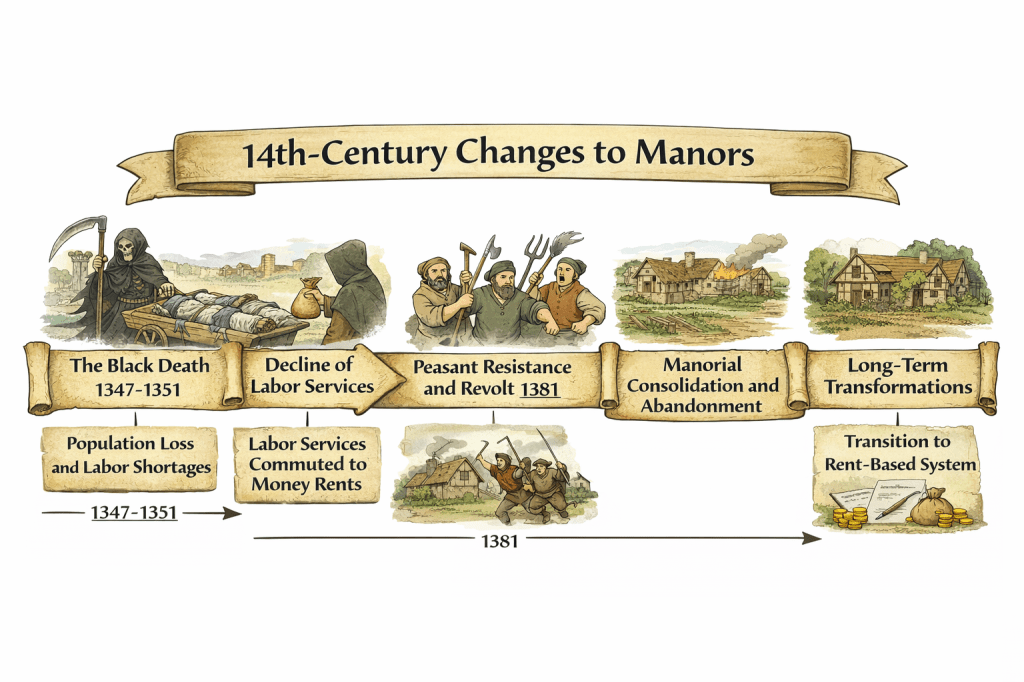
More than once this week I have had to step back from a single line in a roll to consider what it reveals about post-plague tenancy, labour shortages or shifting customary practice.plague tenancy, labour shortages, or shifting customary obligations.
Precision and Patience
There is something deeply satisfying about transforming terse entries into structured explanation. A single line in a court roll might read:
“X amerced 2d for default of suit.”
Unpacking that requires explaining what “default of suit” meant, why attendance at the manor court mattered, how fines functioned economically and symbolically, and what two pence represented in relative terms.
Writing for this project is therefore layered:
- Transcription
- Translation
- Interpretation
- Communication
Each stage builds on the last.
The Rhythm of Medieval Administration
Another thread running through this week’s work has been appreciating the rhythm of manorial governance. Regular court sessions, repeated formulae and recurring names create a steady pulse of rural administration.
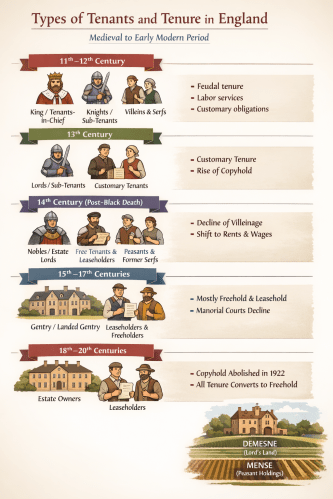
Medieval life was shaped not only by dramatic events, but by routine obligations: paying rents, maintaining hedges, brewing ale according to the assize, presenting at court. Through careful writing, that rhythm becomes visible again.
Understanding medieval processes, procedures and the evolution of the manor also helps us interpret the more readily accessible manorial records of the sixteenth century onwards — a period more familiar to many family and house historians. Without that earlier foundation, later records can easily be misunderstood.
Writing as Reconstruction
More than anything, this week reinforced that writing about manorial records is an act of More than anything, this week has reinforced that writing about manorial records is an act of reconstruction. We work with fragments, conventions and assumptions that were obvious to a fourteenth-century steward but are far less so to us.
Every paragraph demands restraint (avoiding speculation beyond the evidence), clarity (explaining technical terminology), and respect for the source.
It is slow work — but deeply rewarding work.
By the end of the week, I was not simply drafting chapters. I was tracing patterns of authority, obligation and community life that shaped medieval England for centuries.
It has been a productive few days, and I am now ready for the half-term holiday ahead — time with my own family, a chance to reflect on the year so far, and an opportunity to recharge before the spring research begins. There are some exciting projects on the horizon, so do keep watching this space.
 Sarah Pettyfer