Who was my great-grandfather?
I’m sure I’m not alone in asking this question. And whether it’s your great-grandfather or your 4× great-grandfather, the frustration is exactly the same when you just can’t pin them down.
This week I had two genealogy puzzles on my desk:
- Who was my 4× great-grandfather on my paternal side?
- And who was my 2× great-grandfather on my maternal side?
Spoiler alert: both came with brick walls… and a few surprises.
Chasing a 4× Great-Grandfather
On the paternal side I had one small advantage—the surname was fairly unusual, which at least limited the number of possibilities. The first big clue came from my 3× great-grandfather. His burial record (which I’d already found online) gave his age as 52. Straightforward enough… or so I thought.
When I ordered his death certificate from the General Register Office—an early one from 1838—I discovered his age at death was recorded as 47. Five years is a big difference in genealogy terms, so already things weren’t quite adding up.
Then came his marriage in 1815. The marriage register described his wife as a spinster. However, the couple were married by licence, and when I obtained a copy of that licence it described her as a widow. That little detail could make a huge difference if her family is researched further.
So how did I get back another generation? This is where the real brick wall appeared. No civil registration, no census returns—just parish records and educated guesswork. His marriage entry and his children’s baptisms all suggested a connection to St Pancras, St George Hanover Square, or north-east Surrey.
A baptism search around 1792 in those areas produced just one promising result that named both parents. Digging into the father revealed that he’d died the year before his son married, leaving a will that named his wife and three surviving children.
Once I pulled together everything—siblings (six children in total, sadly three dying in infancy), addresses, occupations, and timelines—it became clear this was the right family.
And Then… Another Brick Wall

Next came the 5× great-grandfather.
There were two possible marriages: one in London and one in Shropshire.
The surname clearly had roots in Shropshire, but when I lined up the marriage dates with the baptisms of the children, only one option really worked—the London marriage in December 1783.
The Shropshire couple had their children baptised locally and could be traced there, so they were ruled out. My man died in 1814 and was buried at St Marylebone on 24 April, aged 54… except I couldn’t find a baptism for him anywhere in London, Middlesex, or north Surrey.
So what was going on? Was he never baptised? Have the records not survived? Was his baptism badly indexed—or was he born somewhere else entirely?
A wider search for baptisms around 1760 (give or take five years) turned up just one possibility in Shropshire from 1759, naming both parents. Expanding the search even further brought up possible entries in Cheshire, and that’s before accounting for spelling variations. As he was a butcher, there may be other records out there to find—but for now, this line needs more digging.
A Tougher Line on the Maternal Side
The maternal line came with a different challenge: a very common surname. Thankfully, the repeated use of certain first names helped keep things on track. This research was trickier, but at least I had census returns, civil registration, and electoral records to work with.
Addresses, occupations, and ages proved crucial here—not just for tracing my 2× great-grandfather, but for identifying the 3× great-grandfather as well. In this case, my great-grandfather turned out to be an only child.
The reason became heartbreakingly clear: his parents both died of cholera in 1849, just two days apart, when he was only three years old.
The breakthrough came when I found him living with his grandparents in the 1851 and 1861 census returns. They were still living at the same address they’d occupied in 1841—and it was the very same address recorded on their grandson’s birth certificate.
With no sign of siblings, it was clear his parents must have died young. A quick search of the death index confirmed it. That discovery pushed the family line back into the late 1700s.
Master Mariner Adventures
Finally, this week also included my first visit of 2026 to The National Archives (my second-favourite archive—don’t ask me to choose!). I was researching a Master Mariner from the early 1800s and spent hours searching crew agreements and muster rolls, hoping for a clue about his age or year of birth.

These books are huge. While I did find several relevant ship records, most frustratingly didn’t include age details—although a few do, so there’s always hope! Even without that missing piece, the records still added real depth and colour to his maritime career.
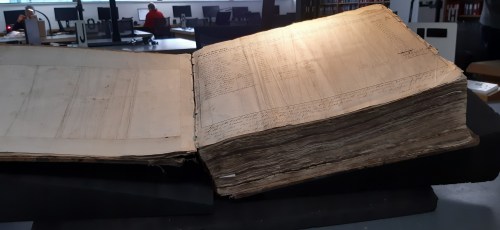
And that’s often the way with genealogy: sometimes you break through the brick wall, and sometimes you just add a bit more flesh to the bones.
Lessons Learned (So Far!)
This week was a good reminder that family history research is rarely straightforward. Ages change, people reinvent themselves, records disagree with each other, and sometimes the answer you’re hoping for simply isn’t there—yet.
A few key lessons stood out:
- Never rely on a single record. Ages, marital status, and even places of origin can vary wildly depending on who provided the information.
- Follow the wider family. Wills, siblings, addresses, and occupations often tell you more than one baptism ever could.
- Be flexible with places and spellings. Just because someone married or died in London doesn’t mean they were born there.
- Brick walls aren’t failures. Even when a line doesn’t move back another generation, adding context—like occupations or maritime careers—brings ancestors to life.
Some questions are answered, others are parked for another day, and a few new ones have appeared along the way. But that’s all part of the fun… and frustration… of genealogy.
 Sarah Pettyfer